

Watkins, Eileen; Exhibition features N.J. artists, The Star Ledger, August 18
EXHIBITION FEATURES N.J. ARTISTS
By Eileen Watkins
Originally published in The Star-Ledger
Newark, NJ
August 18, 1996

Raynor, Vivien; Fresh-Looking Work From Six Veterans With a Wealth of Experience, The New York Times, August 11, 1996

FOR all the youthful implications of its title, ''Six Artists: The 1990's,'' at the State Museum here, is a show about maturity. The work, three-quarters of it produced in the last two years, is certainly new. The artists -- Emma Amos, Bill Barrell, John Goodyear, Gary Kuehn, Patricia Lay and George Segal -- are anything but, Mr. Segal being the eldest, at 72, and Ms. Lay the youngest, at 55. Besides, all are well known in the state, and most have seen the limelight in Manhattan, in particular Mr. Segal, who has been a fixture in the Sidney Janis stable since 1967 in addition to starring at numerous museums, domestic and foreign.
They may appear as new because artists, like wine, need to set awhile. But credit must also go to the organizers of the show: Zoltan Buki, the museum's curator of fine art, and Alison Weld, its assistant curator of contemporary New Jersey arts.
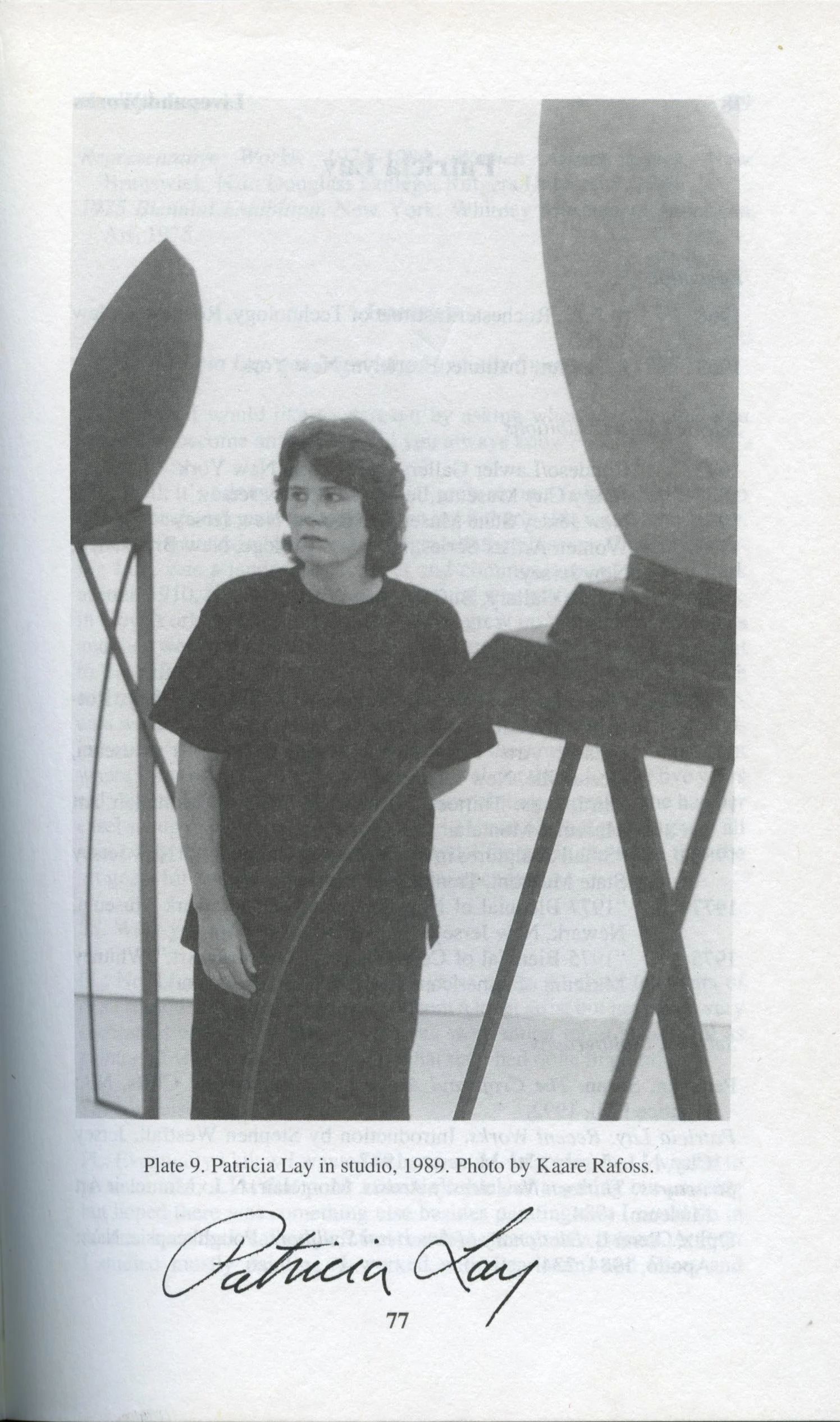
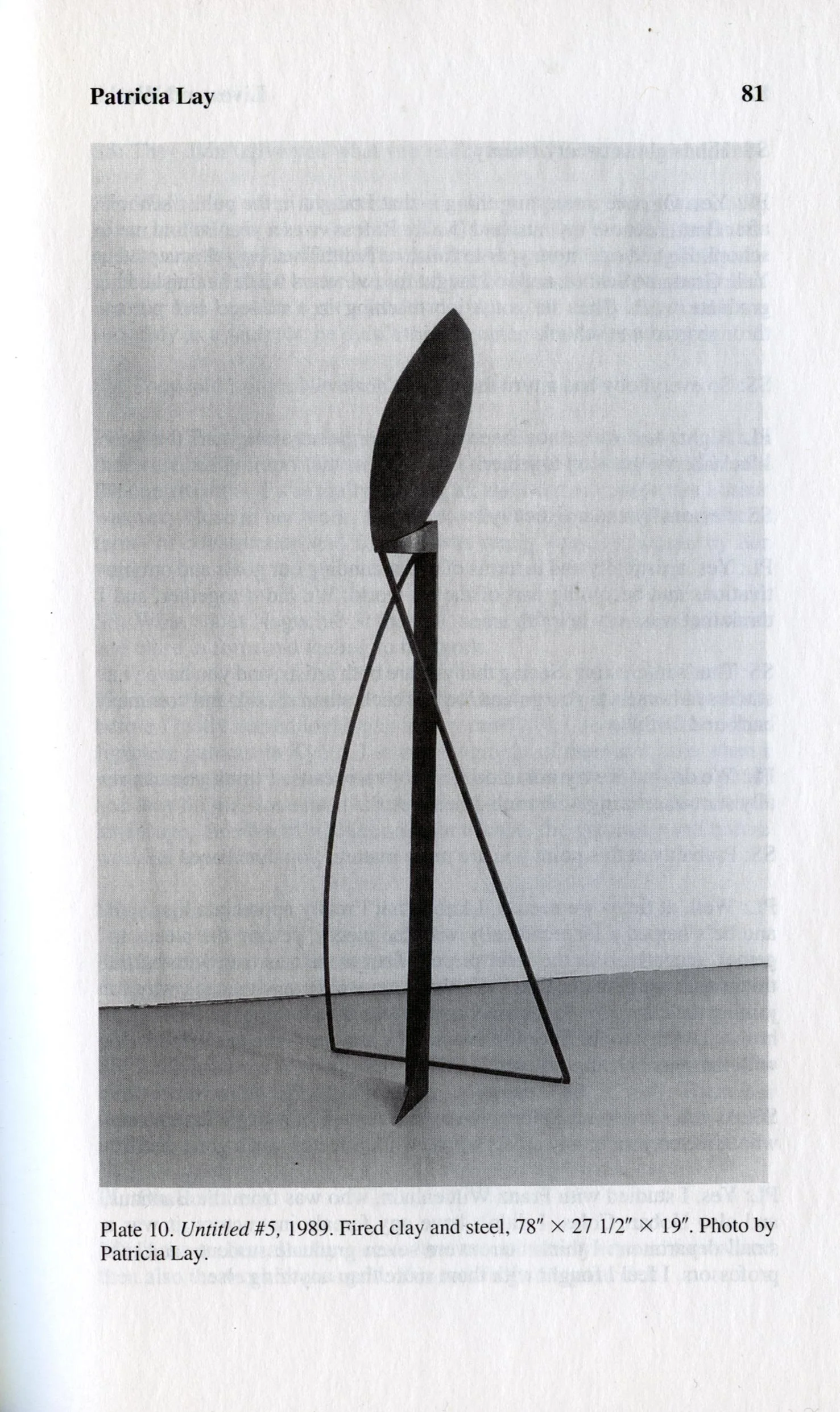
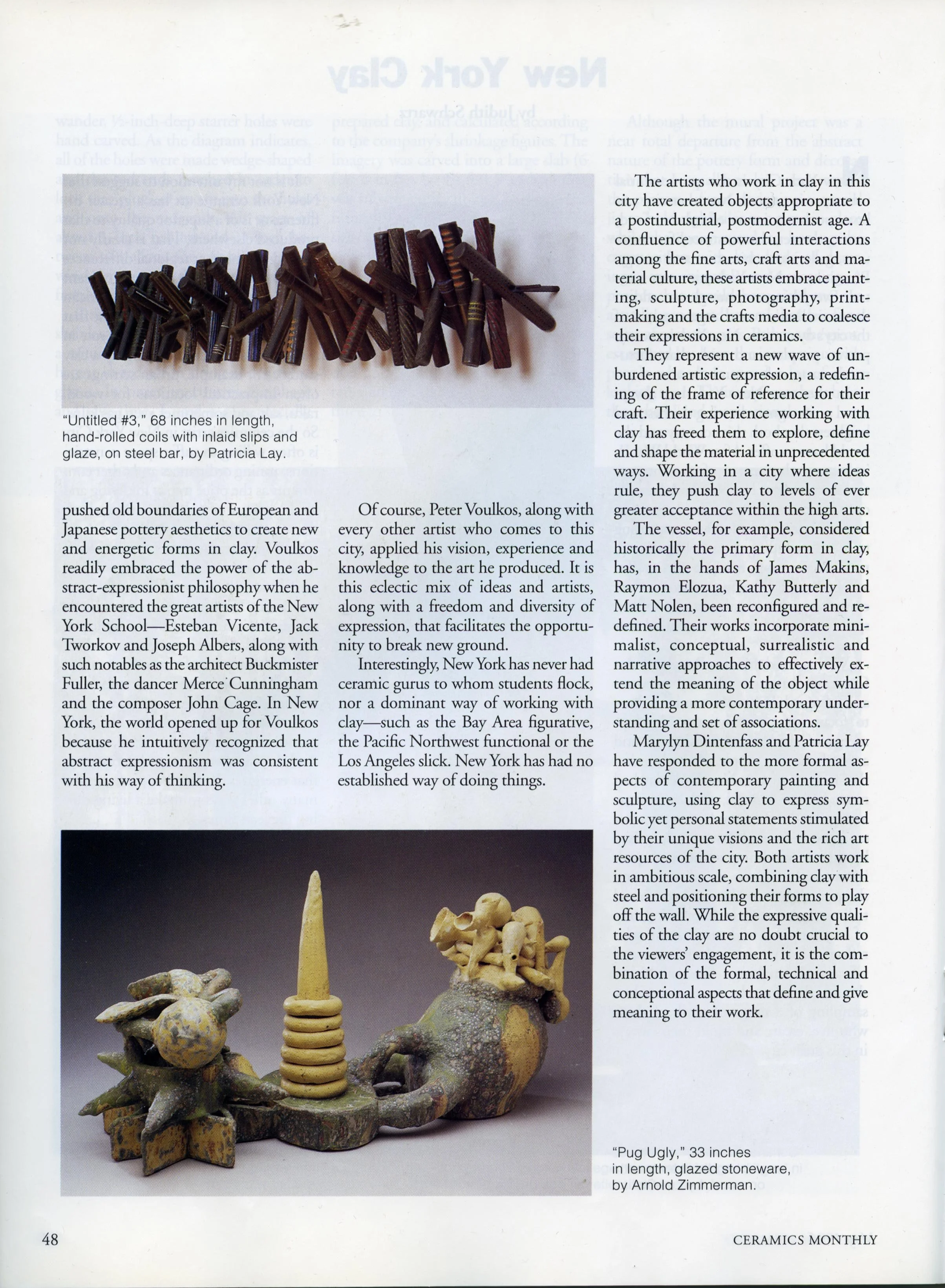
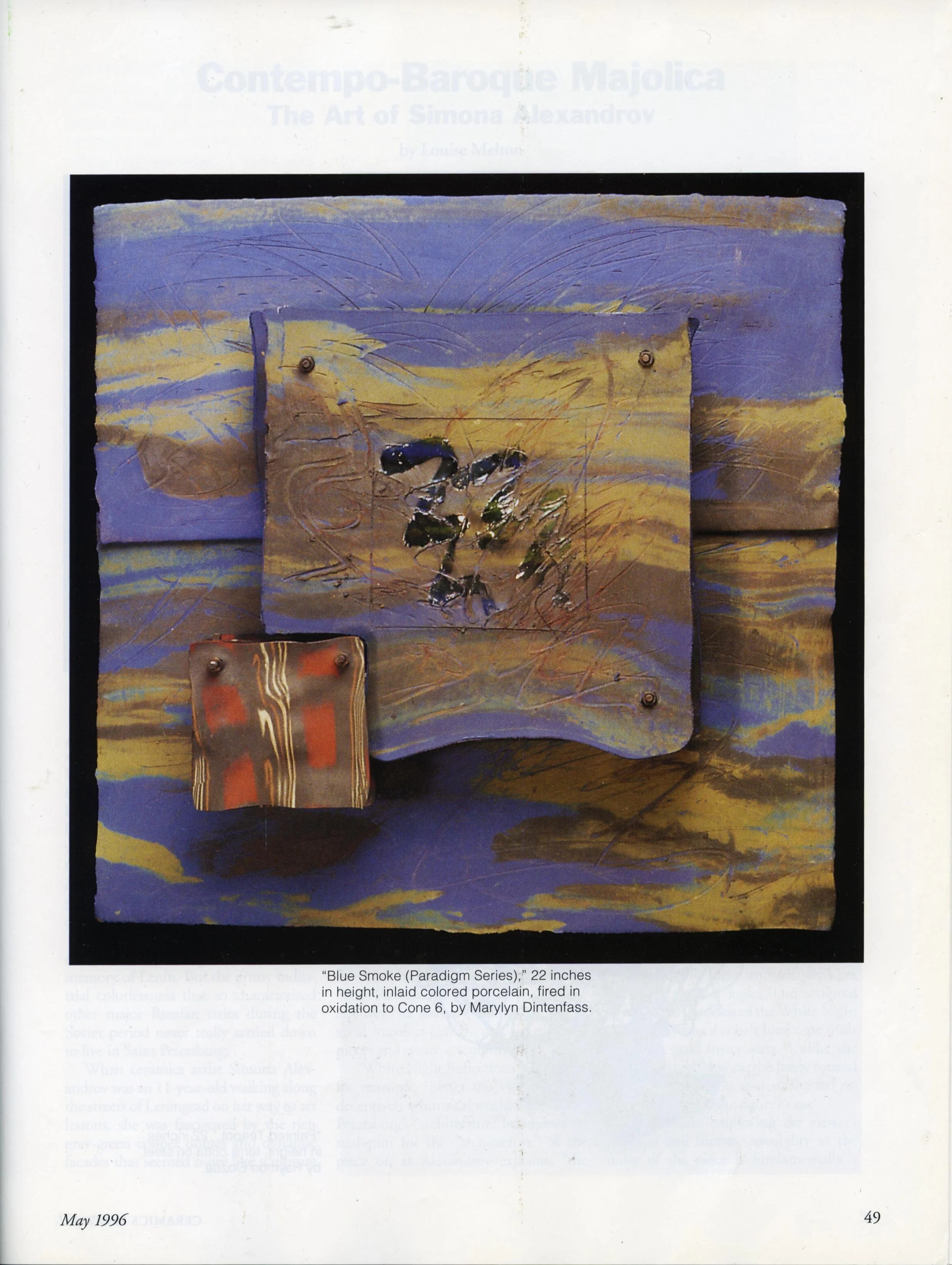
Patricia Lay has long steered a course between art and craft, working in the materials of both but generally tending toward craft in her results. Here, she again combines materials, specifically fired clay and steel rods, but the outcome is monumental in ways that suggest Brancusi and Tony Smith at his most Systemic. The clay is black, but in the case of the bagel shapes threaded on a vertical pole, it comes incised with orange stripes. Other vertical shish kebabs are packed with black shapes resembling vertebrae, while the rods hung on the walls horizontally are strung with geometrical and organic shapes, spaced far apart. As usual, there are intimations of African art, but a label indicates that Ms. Lay's repetitions refer to the tedium of women's work, presumably as opposed to those practiced by the young Sol LeWitt and the old Brancusi.
Emma Amos does not share Ms. Lay's duality, but she alludes to her own past as a weaver by adding collage African fabrics to her paintings; she also incorporates photographs and reproductions. But above all, the artist is concerned with her own life and those of her fellow African-Americans. Hence, a typical Amos work is so filled with personal and socio-political allusions that it requires a key. One overpowering example is the canvas that is half a painting of a seated woman resembling Whoopi Goldberg, attired in pants suit and red boots, and half a scrambled image of Billie Holiday in action. To judge from the artist's caption, buried in this is an allusion to her mother, who made gloves, notably for the singer Hazel Scott, and who loved Holiday more than any man in her life. Her daughter conveys the same intensity in her art.
GARY KUEHN contributes, on the one hand, rectangles of pink, yellow and green paint applied to three panes of plexiglass and incised edge to edge with scribbles and scratches, and, on the other hand, a sequence of three sculptures in wood coated with graphite, all suggesting a torso cut off at the thighs. This begins with a tree trunk forked at top and bottom, continues with a similar form made by joining tree limbs together, and ends with a geometric version assembled out of beams. It is up to the viewer to decide if the shapes represent progress or regress.
John Goodyear is a Minimalist with leanings toward the kinetic, a social conscience and a sense of humor -- an unlikely combination if ever there was one. His canvases, however, are small, square and, in a prim way, rather pretty, especially when the slats of painted wood that screen them like Venetian blinds swing back and forth, casting shadows. Each merits close attention, but none more than ''Chimpanzee Power'' and ''Capital Gains for the Rich.'' The one features a simian silhouette composed of small black squares on a background of yellow; the other is a white canvas filled with golden-brown arabesques undulating like the permed hair styles of the 1930's.
Compared with Mr. Goodyear's installation, Bill Barrell's is a burst of automatism, but one that refers to the world and keeps the same beat, which seems to have accelerated in recent years. Although the images are more easily osmosed than analyzed, most are amalgams of heads, figures, objects, houses and hints of landscape that somehow add up to interiors. Recurring elements like the striped ribbon pique curiosity, but it is not necessary to identify the parts to appreciate the whole. In any event, viewers have their hands full taking in the fauvish color, the range of texture and an attack as vigorous as the late George McNeil's.
Last but not least are the grisaille still lifes representing the sculptor George Segal's return to painting in the early 1990's -- an about-face that appears to have been emotional as well as esthetic. Some images evoke French Realism of the 19th century; others suggest the Cubist Picasso. All are extraordinarily somber in atmosphere. Mr. Segal could be the one artist registering the pulse of the time.
SIX ARTISTS: THE 1990's
New Jersey State Museum
205 West State Street, Trenton
Through Sept. 8. Hours: Tuesdays through Saturdays, 9 A.M. to 4:45 P.M.; Sundays, noon to 5 P.M.
Cotter, Holland; New Jersey Shares Worldly Treasures, The New York Times, July 12, 1996

Excerpt from New York Times Article:
THIS is a fairly low-key summer in New Jersey art museums, with one really spectacular exhibition unfortunately ending its run this weekend in Newark.
New Jersey State Museum
"Six Artists: The 1990's," organized by Zoltan Buki and Alison Weld, holds center stage at the New Jersey State Museum in Trenton. Most of the participants have Manhattan reputations but have been brought together here on a different geographic pretext: they either live or work in New Jersey. (Three teach at Rutgers University.)
George Segal is the best-known figure, though he is represented here by thick-textured, lugubrious grisaille paintings of still lifes rather than his signature sculptures. If nothing else, they underscore the fact that this artist's work has always been closer to Expressionism than to the Pop art with which he is often linked.
Emma Amos and Bill Barrell also fall somewhere in the Expressionist camp, Mr. Barrell with brushy, chromatically bright semi-abstractions, Ms. Amos with a racially charged figurative subject hemmed in by borders stitched from African cloth.
Judging by their quirky, pointed titles ("Laptops for the Poor," "Prayer in Schools"), John Goodyear's paintings also have political subtexts, though they're a little hard to decipher. What catches the attention is their odd format. The diagrammatic images are half-obscured by wooden screens suspended an inch or so from the painting's surfaces, some of which gently sway from side to side.
Like Ms. Amos's work, Patricia Lay's sculpture combines materials (metal and ceramic) associated with both art and craft. She works incrementally in small forms and, whether piled up in thin columns or lined up horizontally on the wall, they keep up a consistently engaging conversation. The show's most striking works, though, are the quietest: tree-trunk sculptures by Gary Kuehn entirely covered with the sheen of pencil graphite, bringing nature and culture into a thought-provoking alliance.
No visitor will want to miss the museum's small but solid permanent collection of work by black artists. It begins in the 19th century with a portrait of a child by Joshua Johnson and landscapes by Robert Duncanson and Edward Mitchell Bannister, then blossoms into real diversity closer to our own time.
The abstract painting by Alma Thomas titled "Wind Tossing Late Autumn Leaves" (1976) is a beauty, with its shower of black curved lines on a white ground. So, in its different way, is Sister Gertrude Morgan's undated "Revelation," with its red-haired angels hoisting megaphone-shaped trumpets and its Four Horsemen of the Apocalypse dressed like cowboys. The collection is brought up to date with strong pieces by Benny Andrews, Mel Edwards, Richard Hunt and Alison Saar.
Skouen, Tina; Arbeiderbladet, Oslo, Norway; July 19
NYTT SKUDD I SKULPTURPARKEN (NEW SHOT IN THE SCULPTURE PARK)
By Tina Skouen
Originally published in Norwegian newspaper Arbeiderbladet
July 19, 1996
