Berecz, Agnes; PAT LAY: MULTIDIMENSIONAL, catalog essay, April 2024
“Lay’s multidimensional work operates in a carefully negotiated space between artistic practices, cultures, and geographic territories. A critical commentary about machines as both necessary tools and substitute deities, she proposes new, hybrid taxonomies that address the technologically mediated human experience where souls and bots, motherboards and pictures of the cosmos coexist.”
Excerpts from: Agnes Berecz; PAT LAY: MULTIDIMENSIONAL, catalog essay, April 2024, Elza Kayal Gallery, NYC

Elza Kayal Gallery
New York, NY
March 15 - April 2024
If dimensions are means of measure that orient and order things and beings, Pat Lay’s work, a practice in many formats and media addressing various histories and cultures, is indeed multidimensional.
Working since the late 1960s, Lay became an artist in the technological society of the second machine age where clear-cut distinctions between body and machine, organic and computational, human and robot have been probed and increasingly destabilized. Deeply engaged with the generative effect of technology on the material conditions and modes of human life, Lay creates sculptures, scrolls, collages and prints by using images and objects from the realm of technology as raw materials and motifs to reimagine the world we share with machines.
In her recent sculpture-series, Soul Bot and Nested Bot, she juxtaposes computer parts such as aluminum heat sinks and cooler fans with vividly colored, fired clay objects whose distorted geometric volumes bear bodily connotations. Amalgams of industrial fragments and hand-made vessels, Soul Bots are part bodies and part objects. By uniting the commercially fabricated, metal computer parts that imply gyrating motion with the stillness of the often amusingly erotic clay bodies, Lay animates and reclaims the object world of contemporary technology.
Trained as a sculptor and working with clay for decades, Lay’s organic robots in the Soul Bot and Nest Bot series also bring into play the historically laden relationship of pedestal and sculpture. In addition to using shelves as well as low and high pedestals to display her sculptures either alone, in pairs or as multipart units, recently Lay also began using collapsed, disordered clay grids, or as she calls them ‘nests,’ to contain and elevate her three-dimensional work. In the 2023 installation, titled Urban Birds, she placed the vaguely ornithological clay vessels on a grid of glazed ceramic tiles. A multipart sculpture situated as an elevated floor piece, Urban Birds indicates a return to the artist’s 1970s floor-based architectural landscapes.
In another instance of circularity, Lay employs the machine parts and the sensual clay bodies of her sculptures as images in Botscapes, a series of digital collages that suggest fragmented, visionary landscapes. Collage has been a primary device in Lay’s practice since the early 2000s when, after working with multipart structures and assemblages and inspired by the kaleidoscopic composition of Tibetan mandalas, she created her first digital collages. Ten years later, she started working on her large-scale, digital and painted collages adopting the vertical scroll format.
Constructed from digital photographs and the enlarged and altered images of computer motherboards, the meticulously composed and both formally and metaphorically layered scrolls feature numerical codes and details of electronic circuits in repetitive, ornamental structures. Reminiscent of the spiritual devices of Himalayan cultures, the painted and collaged scrolls replace pictures of Buddhist deities and narratives with abstract patterns of techno-scientific imagery. In Extreme Deep Field (2014) the artist framed the Hubble telescope’s iconic image of galaxies that are billions of years away from us with diagrammatic patterns of enlarged circuit boards fusing the infinitesimal and the interstellar as well as space and surface.
Like telescopes, Lay’s scrolls and prints are also time machines. Historically aware and diverse in its references, her work brings into play cultural artifacts, scientific inquiries, and spiritual practices across time and space. Her scrolls and prints evoke a matrix of allusions ranging from navigational devices such as maps and charts to decorative objects and spiritual tool like Persian carpets, Tibetan thangkas, and Byzantine mosaics, while they also expand on emblematic methods and strategies of modern and contemporary Western art, including collage, assemblage, and the grid.
As the artist stated, “meditating on the past, present, and future, my scrolls question and critique our paradoxical relationship and obsession with technology and what it now means to be human.”[1] Lay’s multidimensional work operates in a carefully negotiated space between artistic practices, cultures, and geographic territories. A critical commentary about machines as both necessary tools and substitute deities, she proposes new, hybrid taxonomies that address the technologically mediated human experience where souls and bots, motherboards and pictures of the cosmos coexist.
Ágnes Berecz
(PhD University of Paris I, Pantheon-Sorbonne) is an art historian and a critic. The author of the monograph, Simon Hantai (2013), and 100 Years, 100 Artworks: A History of Modern and Contemporary Art (2019), Berecz teaches contemporary art at Pratt Institute and lectures at the Museum of Modern Art.
Naves, Mario; Now at New York’s Galleries, ‘Everything in the World’ and More, New York Sun, March 22, 2024

nysun.co
Mario Naves, March 22, 2024
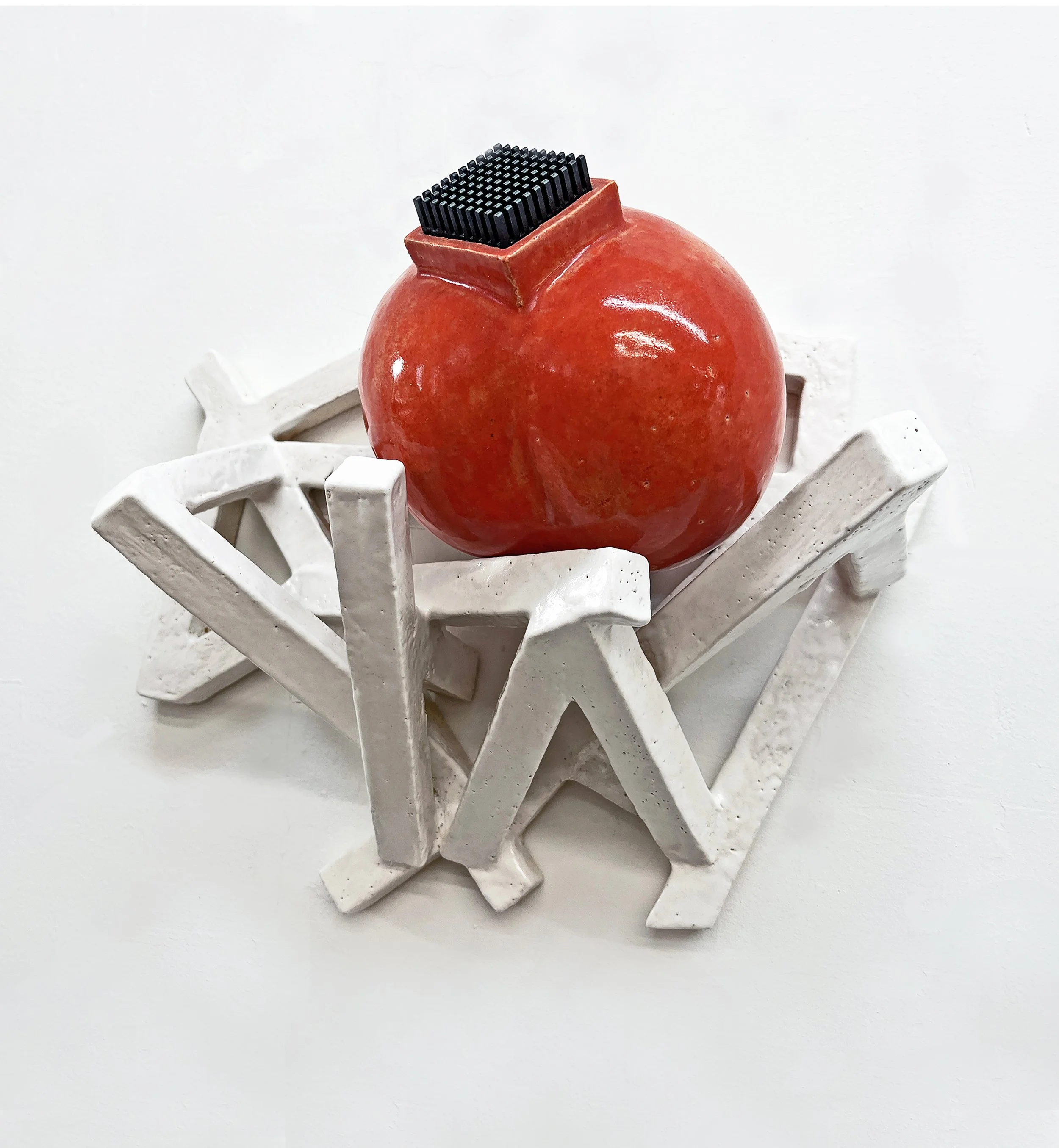
Pat Lay, ‘Nesting Bot X2C2’ (2024). Via Elza Kayal Gallery
Excerpt from NY Sun Article:
Human beings or, rather, the compromises to which humankind is invariably confronted, are at the center of “Multidimensional,” an array of prints, collages, and sculptures by Pat Lay at Elza Kayal Gallery. A veteran of the New York City art scene — she was, lest we forget, featured in the 1975 edition of the Whitney Biennial — Ms. Lay has long been exploring the relationship between the technological and the organic, the machine-made and the hand-crafted.
Ms. Lay’s investigation into artificial intelligence and human integrity precedes our current fixation with the topic. She addresses the issue not with alarm or hyperbole, but with subtlety and wit, particularly in a series of supple ceramic biomorphs that are punctuated by repurposed computer parts.
The best of the bunch is “Nesting Bot X2C2” (2024), in which a bulbous form, glazed a rich burnt orange, is propped up by an accumulation of braces colored a milky white. Here the animism at the center of Ms. Lay’s vision is rendered precarious — as if the scaffolding on which her “hybrid taxonomy” snuggles is as sentient and fragile as its charge.