Point, George; Art View With Politics At City Hall, Jersey Journal
ART VIES WITH POLITICS AT CITY HALL
By George Point
Originally published in The Jersey Journal, January 3, 1991

Filler, Marion; Lesson to be learned at show, Daily Record, July 29
Lesson to be learned at show
Originally published in Daily Record, Morristown, NJ
July 29, 1990

Art, August 3, 1990, Star-Ledger, Newark, NJ
By Eileen Watkins
Originally published in The Star-Ledger

Teachers & Their Students: Two Generations of Sculptors, Town Topics, Princeton, NJ.; July 25
Originally published in Town Topics, Princeton, N.J.
July 25, 1990

Raynor, Vivien; Sculptures That Test the Idea of Opposites, October 1, 1989

''MATERIAL FORMS'' is a show by 10 sculptors at the New Jersey Center for Visual Arts here. The brochure says that it ''explores the tensions created between surface and volume, natural and man-made materials, abstraction and representation, ancient and modern civilization.''
Real or imagined, tension is still very fashionable; so is the notion of tireless exploration. As for proposing irreconcilable opposites, then finding them reconciled, this, too, is the stuff of art explication, especially when the subject is sculpture. But so what if the verbiage is routine puffery: the show it accompanies, though too large for the gallery, has been well chosen by its curators, Pat Kettering and Hanna Woicke.
Ralph Caparulo and Bisa Washington are among those practicing assemblage. On second thought, this is not the precise word for what Mr. Caparulo does, which is to carve small effigies and group them with other forms, most carved, a few ''found,'' and stain the whole sepia black.
A typical example is ''Cloud Carrier II,'' where a friarlike figure, crisscrossed with twine, stands on an irregularly shaped base. A carved dragonfly stained red perches on the head of the figure; wood bundles are bound to its back. A parcel with posts stationed at all four corners reposes below, and the entire spectacle is mounted on a trolley, like a toy.
The similarly cowled personage presiding over ''Savonarola's Friend'' has wings shaped like Mickey Mouse's ears on its back and a gilded moth at its feet. Though Mr. Caparulo seems to be trying for a blend of the magic in Catholic icons and that projected by African fetishes, what he achieves is Surrealism, although of a very personal kind.
Few of the works reflect the direct influence of tribal art, yet the cumulative effect of the show is to remind the viewer of how powerful its influence on Western sculpture has been. Interestingly enough, the artists who use the word ''power'' in their statements are both of African descent - Ms. Washington and Willie Cole.
Mr. Cole's intention is to intimate not only power but the ''symbiosis between primitive and modern culture.'' The most noteworthy results are the latticework jacket woven with strips of galvanized metal and ''Post-Atomic Dog.'' This creature, its jaws open to reveal multiple copper tongues, is a direct descendant of West African nail sculptures, except that the nails taper off at the animal's rear end - the result of radiation?
Ms. Washington's ''St. Michael's Shrine'' is a true assemblage where cables bound with black or red cloth snake around a picture of the saint in armor and are accompanied by strings of cowries, a row of old chisels, a pile of pennies and a rattle made from a gourd. Art, to quote Ms. Washington, is ''the power to make things happen'' and the ''battery'' providing the power is the juju influence symbolized by the ''weaving, wrapping, knotting and other fiber techniques'' that she uses. These accumulations plus Mr. Cole's dog and to a lesser extent the constructions of Mr. Caparulo stand apart as presences not to be trifled with.
A virtuoso carver, Ed Visser reduces tall oak beams to shapes suggesting oversized mussel shells and the kind of forms that result when carpeting or some other inert substance is flopped over a bar. The perversity is never more disconcerting than in the laminated piece of which the artist himself says that ''the stretched membrane-like form almost jeopardizes the structure.''
Ken Horii is also a virtuoso, but his medium is plywood and his method, though it hardly describes what he does with this intractable material, is lamination. ''Thousand Raptures'' is a six-foot-tall shape that bulges in the middle as if germinating and tapers to flanges at top and bottom. Defining this huge pod are bands that are alternately wide and slashed with vertical cuts and narrow and plain, except at the top and bottom, where they are consistently narrow. Still, the most attractive of Mr. Horii's works is the pair of tall stakes, each with a chunky bun-like shape impaled on it, shish kebab-style.
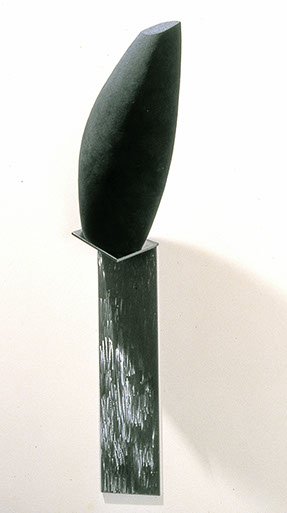
Patricia Lay's clay and steel compositions are larger than those in the recent State Council on the Arts Fellowship Show at the Noyes Museum, and she looks all the better for it. Her best effort stands more than six feet tall, its straight and curving bands of steel implying a figure, the crowning football shape in brown clay a head.
Another Fellow, Elaine Lorenz, shows statements about the war between man and nature. One is the double ''sandwich'' of moss between slabs of concrete that was in the Noyes show; another is a concrete envelope bisected to show box leaves within.
An artist born in Moscow, Matvey Levenstein offers work that seems Minimalist but is actually fraught with ideological significance. This is too complicated to summarize here, but viewers may rest assured that ''Rural Virtues'' is much more than the shallow concrete bathtub on polished wood supports that it appears to be.
The constructions of Sonia Chusit allude to ancient Egypt, as before, but now seem more influenced by Jasper Johns. ''Keeper of the Secrets'' may be a snarling dog modeled in clay, but the secrets - a tapering pile of rough wood boxes - bear cryptic messages stenciled in the lettering that Mr. Johns has made his own. This, together with the ukelele-like shape that has an applique of lead sheeting incised with more esoterica, indicates that Ms. Chusit, for all her preoccupation with mythology, remains closer to the present than the past.
Nancy Cohen hogs the stage with amalgams of wood, metal, cloth, Styrofoam and cement, all of which are irrepressibly organic. The best is the relatively simple ''Trio,'' a cluster of fleshy shapes in black with indentations painted pink that arouses associations with marine organisms from tropical waters.
The show is on view through Oct. 22 at the center, which is at 68 Elm Street in Summit. The hours are noon to 4 P.M. weekdays and 2 to 4 P.M. weekends.
Westfall, Stephen; Patricia Lay. Recent Work, Jersey City Museum, brochure
PATRICIA LAY: RECENT WORK
Stephen Westfall, 1987
Jersey City Museum, Jersey City, NJ
This is a fitting moment for a survey of Pat Lay’s recent sculpture. There is a resurgent interest in sculpture in general and particularly in an abstract sculpture that restores some associative play to its vocabulary. The literalist doctrines of the Minimalist geometries that dominated so much of the ’60s and ’70s sculpture are now regarded as both naive and no fun. Hypocritical too, for in declining the Romantic Mannerism of late Abstract Expressionism and Pop’s built-in consumerist giggle, Minimalism was in part Pop’s substituting its own Romantic cultification of artful, black and white installation shots and no-nonsense interviews. Lay’s work yields nothing to Minimalism in its formal rigor, but her formalism is at the service of a recombinant attitude that invites association and thrives on the bringing-together of wildly contrasting materials and volumes.
Lay’s new sculpture combines steel planes welded into geometric structures that cradle and conceal pointed, football-shaped ceramic volumes. The ceramics can be read as “abstract” geometric forms, but organic associations — leaf, bud, fish — are present. These associations are furthered by the contrast between the curving and swelling ceramics and the straight-edged planes of steel armature is oddly psychological — projecting hard-edged (literally) geometry into the arena of organic sentience. And the precious floral surprise of the simultaneously lush and brittle color of the slip-glaze coating the ceramic form gives you a sense that what is being held there is worth shielding. The vertical striations scoring the chalky, luminous slip will expand across the forms until they correspond with a metal edge that is being overlapped. Thus, an unexpectedly complex interchange that is both psychological and formal is set in motion between the ceramic and metal elements. The interchange, a friction that generates metaphor, becomes an integration mediated by the unifying compactness of this body of work.

Zimmer, William; FELLOWSHIP WINNERS AT NABISCO GALLERY, The New York Times, March 18, 1984

EAST HANOVER WORKS by 26 artists who received ''first-priority ranking'' among 90 winners of the 1984 Visual Art Fellowships awarded by the State Council on the Arts are on view at Nabisco Inc.'s USA Gallery through March 28.
Such a competition, involving diverse media and styles, is well suited to the gallery, which is essentially the bright and capacious lobby of Nabisco's corporate headquarters.
There is no solemnity about the place. It resembles a hotel lobby or airline terminal, and must be traversed by anyone doing business at Nabisco.
There is no way to quarrel with the council's selections because one has no access to the work of the more than 400 fellowship applicants, but fault can be found with the scant information provided a visitor.
There is no biographical information on the exhibitors; since part of the interest in a show like this is sociological, this is an acute omission.
For better or worse, one detects a quota system at work, as if the judges took pains to admit a certain amount of crafts, visionary plans or abstract painting among the representational ones, but then it might be argued that it is essential to represent the breadth of art in New Jersey.
Also, this reviewer secretly delights in being faced with an amorphous presentation and charged with making conclusions or discovering an unknown artist who is a good candidate for real success.
It often has been observed that photography in New Jersey is practiced with unusual commitment. William Aranowicz makes one care about some neglected places and, especially, about advertising from bygone eras. His ''Girl in First Communion Gown in Perth Amboy, N.J.'' harkens back to some of the heroic photographs of the Depression.
Joseph Paduono has a unique printing technique that makes his photographs, mostly of resorts on the Jersey Shore, look like silverpoint etchings and thus nostalgic. Geanna Merola's photographs are not purebred; there are many drawn elements mixed in with photographed ones, but, as is often the case, innovative technique does not hold its own against banal subject matter.
Neo-Expressionism, which is currently giving artists everywhere license to paint gesturally (which is often translated into carelessly), has some adherents in this show. They are not bad, although with Alison Gordon Weld it is her unusual support - shower curtains - that holds our attention more than her imagery.
Celia Parker's paintings are likable for the way her brush stroke becomes the swirls of liquid in crude pastel- colored renderings of tea, coffee and cafe con leche being prepared in outsized cups.
To be sure, Neo-Expressionism does not always involve gestural paintings. Folk or naive styles find a place, too. Elio Beltran can impressively shift scale from a panoramic crowd scene in ''Cabildo en la Loma'' to the near surreality of ''Transitions,'' in which a man contemplates a dead bird in a cage that overhangs a railroad yard. This painting has both political and personal overtones that cannot be precisely defined.
The most astute abstract painting here is by Gail Buono. In ''Garden State Memory'' and ''Night Driver,'' she pares the landscape down to the highway and reproduces in abstract terms the sensation that a driver peripherally experiences.
Kaare Rafoss's ''Junction Relief,'' which employs white industrial tile and colors out of Matisse, is very fine, but dullness infects the abstractions of Hiroshi Murata and Peter A. Stroud. However, it must be conceded that, at a distance, Mr. Murata's insistant grid system acquires a jauntiness that allows the bright colors he employs to spring to life.
Much of the work in this exhibition belongs to the ''show me'' category. This is work that depends heavily on novelty, and, on rare occasions, novelty enriches art in genuine ways.
However, the tall, wooden lotus flower that grows out of a piece of furniture that Kenneth Ray Fisher calls a ''swamp cabinet'' would only be a nuisance to anyone using the cabinet.
The concrete sculpture of Clyde Lynds has hair-thin cracks and some kind of lighting system. The hefty gray of the sculpture is lightened by the threads of illumination that result.
Mr. Lynds's ''Hotel du Nord for Cornell,'' made of optical fibers, is a massive starry backdrop against which one might imagine Joseph Cornell placing some poignant imagery.
The closer that Patricia Lay's plans for sight sculptures come to real embodiment, the more they communicate to the viewer. Her drawn plans are either unreadable or too technical, but the sleek, curving models in wood, plaster and gouache make us hope that some day the real, full-scale thing might be experienced.
Debra Weir has borrowed a medium that delights children, the pop-out book, and adapted it to some paper sculptures that have power because of their ability to collapse and lie low or to rise up in demonstration of their verve.
The ''pi ece de resistance'' of the entire exhibition is Bob Eustace's work. His paintings are tableaux that take place in a format like a shallow pan.
The heroes are the myriad of small toy figures collected by children. Mr. Eustace constructs wonderful settings for them, and puts the figures to visionary use that mediates between the whimsical and the obsessionally bizarre.
Mr. Eustace's titles, among them ''The Altar of Heaven/The New Jerusalem,'' ''The 12th Hour'' and ''Peter's Vision at Joppa,'' hint that he is deadly serious about his work. But if Mr. Eustace is bound for glory as an artist, he should realize that making paintings is not his forte.
His two large acrylic canvasses fall far below the tableaux. However, imperfection is not fatal in an exhibition such as this; rather, it adds salt.


Schjeldahl, Peter; New Jersey Art at Trenton, The New York Times, November 25, 1979

THE Second Biennial of New Jersey Artists — it will be at the State Museum here through next Sunday — is the first art show in New Jersey that I've ever reviewed, and I approached frankly curious. What is a New Jersey artist?
In recent years, the term “regional art” has gained new respectability, and formerly insular New York critics have found native things to praise from Seattle to New Orleans. But what can be expected from a “region” jammed between mighty Manhattan and the lesser, but still weighty, eminence of Philadelphia?
Judging from the 115 artists represented in the Trenton exhibition, the answer seems to be: Almost anything, but particularly a high degree of tech
Although there is no great ‘spirit of place,’ there is a high degree of technical competence nical competence and a predilection for photography and realist painting.
There's no great “spirit of place,” unless an occasional view of boardwalks or of suburban sprawl qualifies. What there is is a certain alertness to tendencies in the nation's major art centers — photography and a revived realism in painting have been hot tickets throughout the 1970's — combined with a relaxed, personal and somewhat conservative overall tone.
A tending of private gardens, not an ambitious inflation, seems to be the common aim.
It is always possible, of course, that such general impressions are created by whoever selects the works to be shown, in this case from 857 entries. The jurors were Janet Kardon, director of the Institute of Contemporary Art at the University of Pennsylvania, whose tastes I do not know, and William Bailey, who teaches at Yale and whom I do know to be a distinguished painter of in tensely precise, hermetic still‐lifes.
Mr. Bailey's tastes might account for the dominance of realism in the exhibition, although the only work that seems faintly Bailey‐esque isn't realist or even a painting, but an impressive sculptural relief by Herk van Tongeren of Princeton. It is a little lead‐clad bronze chamber of geometric forms with “metaphysical” overtones.
The size of the photography contingent, reflecting this medium's recent prestige, is evidently unprecedented for this show. (The Biennial, mounted alternately by the State and Newark Museums, had a long previous history as an annual.)
Not quite a third of the works on display are photographs. Most of them, like most of the realist paintings, feature unpeopled landscape and cityscape, with a bent (unlike the paintings) for severe “formalist” composition.
I found the bulk of the photographs proficient, but rather ordinary. But there's something surefire about uninhabited boardwalk shots.
I was moved by Jonathan M. Block's and Stuart Thomas's contributions to this genre, as I was by Peteris Krumins's wintry Coney Island beach, Suzan Cook's eerie boarding‐house stairway, William C. Abramowicz's dream‐like “Hoboken Terminal” and Harry Kalish's fine, somewhat AnselAdamsish “Lone Tree Along the Shore.”
Realist painting, as I've suggested, supplies the show's largest pleasures, but one of these is technically an outsized drawing: Katia Gushue's “Blue Ridge Mountains.” Done in pencil on an eight‐foot canvas, it is a softly atmospheric, epic view of rolling, forested peaks that seem to declare color an unnecessary vulgarity.
But I also liked Mel Leipzig's painterly “The House at Night,” a sort of open‐ended story painting in which bathrobed woman awaits the viewer on the lighted porch of a suburban house.
Other high points are Richard J. Fiorino's luminous watercolor of a mobile home and William A. Griffith's watercolor of the Pulaski Skyway raked by a glaring, Charles Burchfieldlike winter light.
A particular wonderment for me was Adolf Konrad's enchantingly elegant reverie on a country estate, a kind of rebus about time and illusion that would take pages to describe adequately.
Abstract painting may not fare very well in this show — exceptions include the contributions of Lewis Rudolph, Robert Kirschbaum and Ellen K. Levy — but the sculpture is mostly abstract and mostly quite good.
There are Patricia Lay's bristling arrangement of variously glazed ceramic pyramids, Lila Ryan's totemic doodles in aluminum, Jane Teller's vaguely ritualistic arrangement of carved driftwood, Troy West's virtuoso welding and Carol D. Westfall's insouciant fiber work.
As for works with an avant‐garde flavor, Liza Nanni's seven altered photographs called “Radioactive Panels,” in which two metai sheets and a wooden frame exchange sinister effluvia in a gravel pit, are probably the most radical entry. (This, truly, is conservative exhibition, not that there's anything wrong with that.)
New York critics travel to see things they don't see at home. Thus, I don't regret the absence of New Jersey's better‐known artists, among them George Segal of New Brunswick and Catherine Murphy, Jersey City's master realist.
I do rather regret the complete lack of “naive,” down‐home painting, a frequent pleasure of regional shows that must surely have exponents in New Jersey. As it happens, absolutely every one of these 115 artists is new to me, and I'm glad to have made their acquaintance.
Most of the works on display are for sale, and most are reasonably priced. Still, red dots indicating a sale were few and far between when I saw the show. This seems a shame. In the long run, an art community is only as strong as its local support.


