Spotlight on Pat Lay: Bending the Grid: Myth, Memory and Android Dreams, Aljira Blog, March 8, 2016

Bending the Grid: Pat Lay: Myth, Memory and Android Dreams is a major survey exhibition that presents for the first time a broadened view of Lay’s expansive life and work – in two and three dimensions – in a range of media and styles, influenced by her travels and informed by her overlapping art and non-art interests. In Thailand, Cambodia and India, Lay was struck by the impact and spiritual beauty of Buddha and Hindu deities and in the power emanating from the idealized human form.
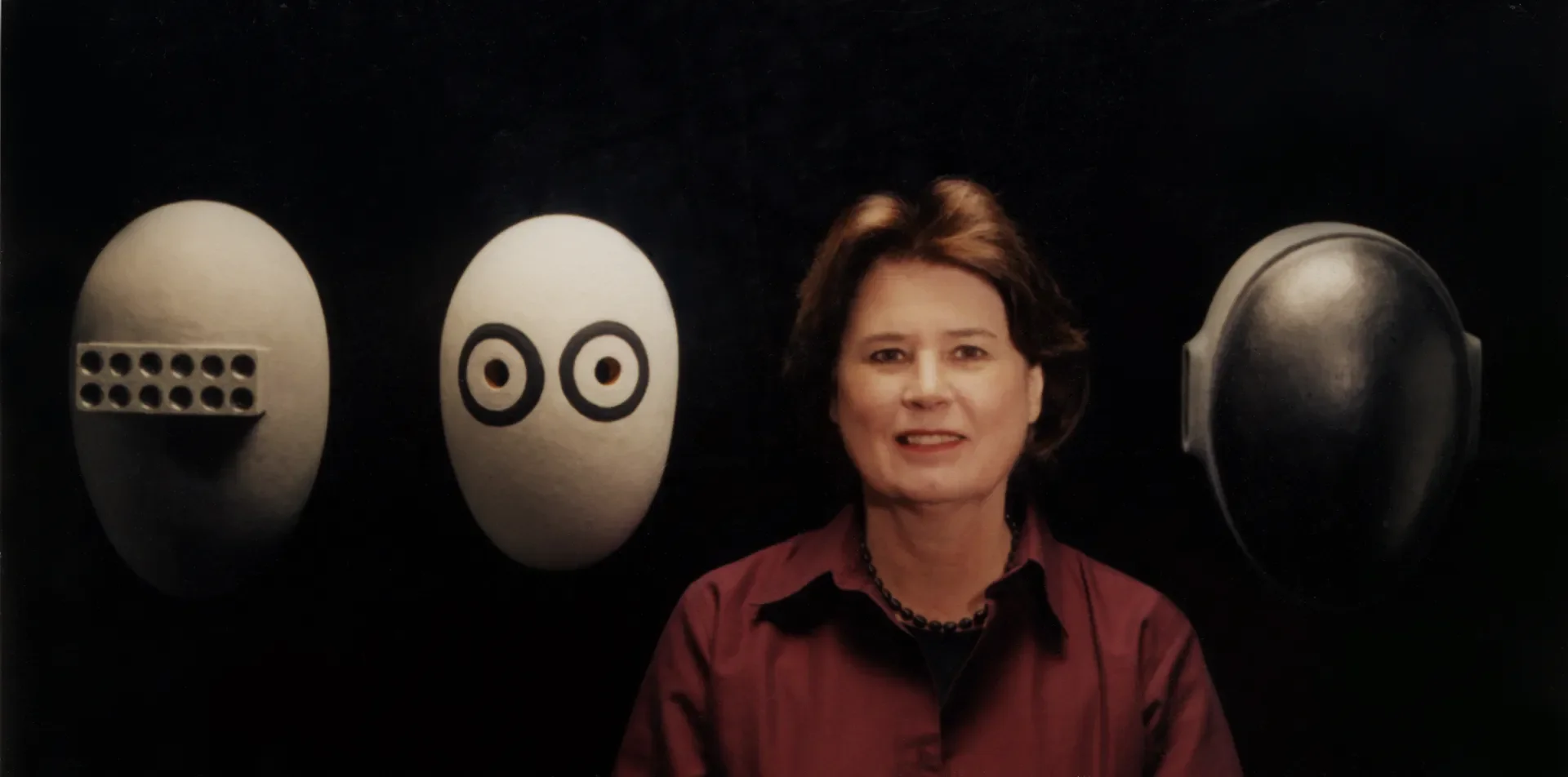
Photo Credit: Robert H. Douglas
“By the 1960s and 70s, Americans could no longer maintain a blinkered, isolationist stance regarding the non-Western world. Nor did most want to. How do you keep them down on the farm once they have seen Paree (and beyond) was a question from a popular World War I song. The answer is: you can’t. Our intertwined world continues to grow ever smaller, connected by air, land, sea, and instantaneously, miraculously, by intangible global networks of all kinds – for better or worse,” notes Guest Curator Lilly Wei in the exhibition’s fully illustrated catalog. “Lay, intrigued, speculates on the impact of artificial intelligence in the future, from computers to cyborgs to the yet to be imagined,” writes Wei.
Lilly Wei is a New York-based independent curator and critic whose focus is contemporary art. She has written regularly for Art in America since 1984 and is a contributing writer and editor for various national and international publications, including ARTnews, Sculpture Magazine and Art and Auction, among others. She is the author of numerous exhibition catalogs and brochures, and has curated exhibitions in the United States, Europe and Asia. Wei lectures on critical and curatorial practices and serves on advisory committees, review panels and the boards of several art institutions and organizations.
On March 12, 2016 Pat Lay and Lilly Wei will be joined by Visiting Curator Dexter Wimberly in conversation at Aljira. A fully illustrated catalog with an essay by Lilly Wei and interview with Patterson Sims is available to purchase. Here Pat Lay shares more about the exhibition and her process.
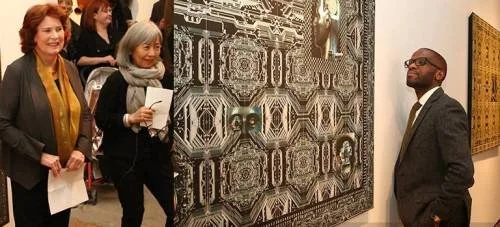
Pat Lay, Lilly Wei and Dexter Wimberly at opening reception (Photo Credit: Akintola Hanif)
ALJIRA: How does it feel to see and present your work spanning so many years in this major survey?
LAY: I’ve never seen it all in one place. Some of the work was stored in my basement and I hadn’t seen it in 30 years. I was hoping everything was still in tact. Seeing the work after 30 years was one thing and seeing it all together was a wow moment.
In the beginning stages, it was really about archiving the work, collecting it with all of the important information I needed: dates, materials, etc. It’s an important thing for an artist to do, because what it leads to is a real understanding of the process and development of the work, how it all ties together from earlier work to later work. You can see the progression. I’ve always told students that they should start their archive right away and just keep adding to it as they make their work. If I’m invited into a show and they say they need photographs and dimensions, I have it.
Working through the technical aspects of the installation process and how things are installed taught me a lot. I learned there are a lot of things I wouldn’t do again. I intend to keep making sculpture but, I think in the future I will make things that are easier to install. It was definitely labor intensive.
It’s really important to work with a curator on a show like this. In putting the show together I had an idea of how I wanted it to be. Lilly had a different idea and she was right. She’s had a lot more experience putting shows together and she’s someone I’ve known for many years. The fact that she’s a woman had a lot to do with my decision to work with her. I wanted more work and she kept eliminating things. She was absolutely right. There are 64 works in the show.
Now that the show is up, it helps me think about what I want to do going forward. For a while, I’m going to make smaller pieces. I’ve gotten very excited about color. I’d like to continue with color and I may be finished with the figurative. My early work is all abstract. At one point I started using the figure. I may be interested in going back to abstract work.
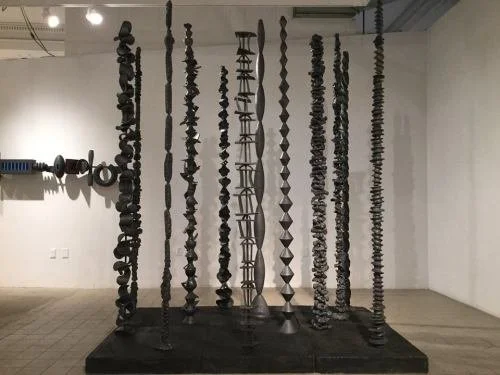
Spirit Poles, 1992, Fired clay, glaze, steel
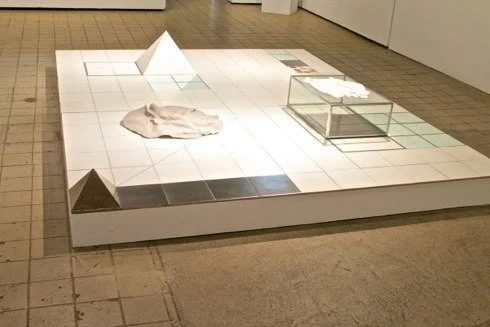
Untitled #3, 1973, Fired clay, steel, glass, wood, 109 x 86 x 12 (Installation Photo: Arlington Withers)
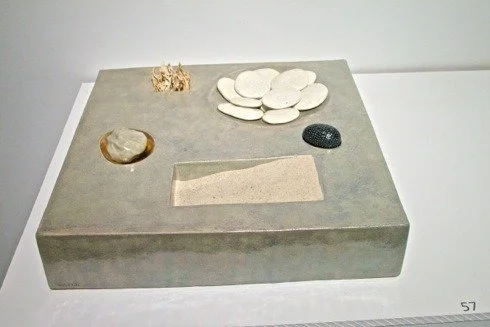
Untitled #3, 1973, Fired clay, glaze, sand, 17 x 17 x 4, New Jersey State Museum L.B. Wescott Collection (Installation Photo: Arlington Withers)
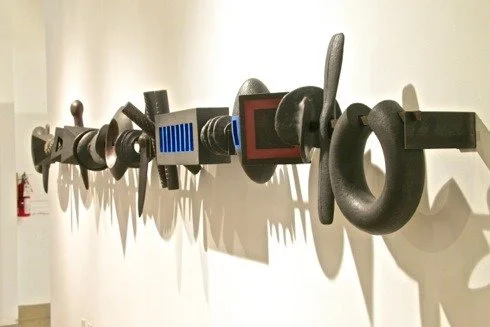
Anthology, 1996, Fired clay, glaze, steel, 92 x 84 x 84 (Installation Photo: Arlington Withers)
ALJIRA: What was the process for making the benefit prints and the digital collage work?
LAY: The benefit prints are based on the larger scrolls and I was excited to do them. The actual printing was done by Szilvia Revesz. She’s been our studio assistant for about 12 years. She’s primarily interested in works on paper and printing techniques, so this was right up her alley. The benefit prints are digital and silkscreen. There are three screens; two colors plus a metallic and then the digital. It starts with a digital image, then we put the screen colors over that. I was excited about the metallic screen printing ink in them, too. The copper, silver and gold have a very beautiful quality to them. The large scrolls are not something that can be framed and they are kind of vulnerable. Sometimes taking the idea to a smaller scale makes it easier to handle and more sellable. Because the prints are small I can just keep making them. It’s a way of working that feels like I could keep going. It’s the first time I ever made prints. It’s something I always wanted to do and I never had the opportunity or reason to do it. This was it.
The digital works like “SFL40V0 #17″ are collaged together or tiled. They’re squared and the edges are borders. It’s made of lots of little parts. It’s easy to print them since I have a 13 x 19 printer at home. The beauty of collage is you can move them around until you get what you want. I had the pieces on my floor and just kept moving the pieces around until it made sense. People ask me: “why don’t you put it all together on the computer?” I did that with the prints but the thing I like in the larger pieces, like the scrolls, is the handmade quality of it. They show the hand and the process.
Much of my process is just intuitive. A lot of it is play, which is a really important word in my work. Playing with the materials and letting things happen. Seeing what the materials want to do.
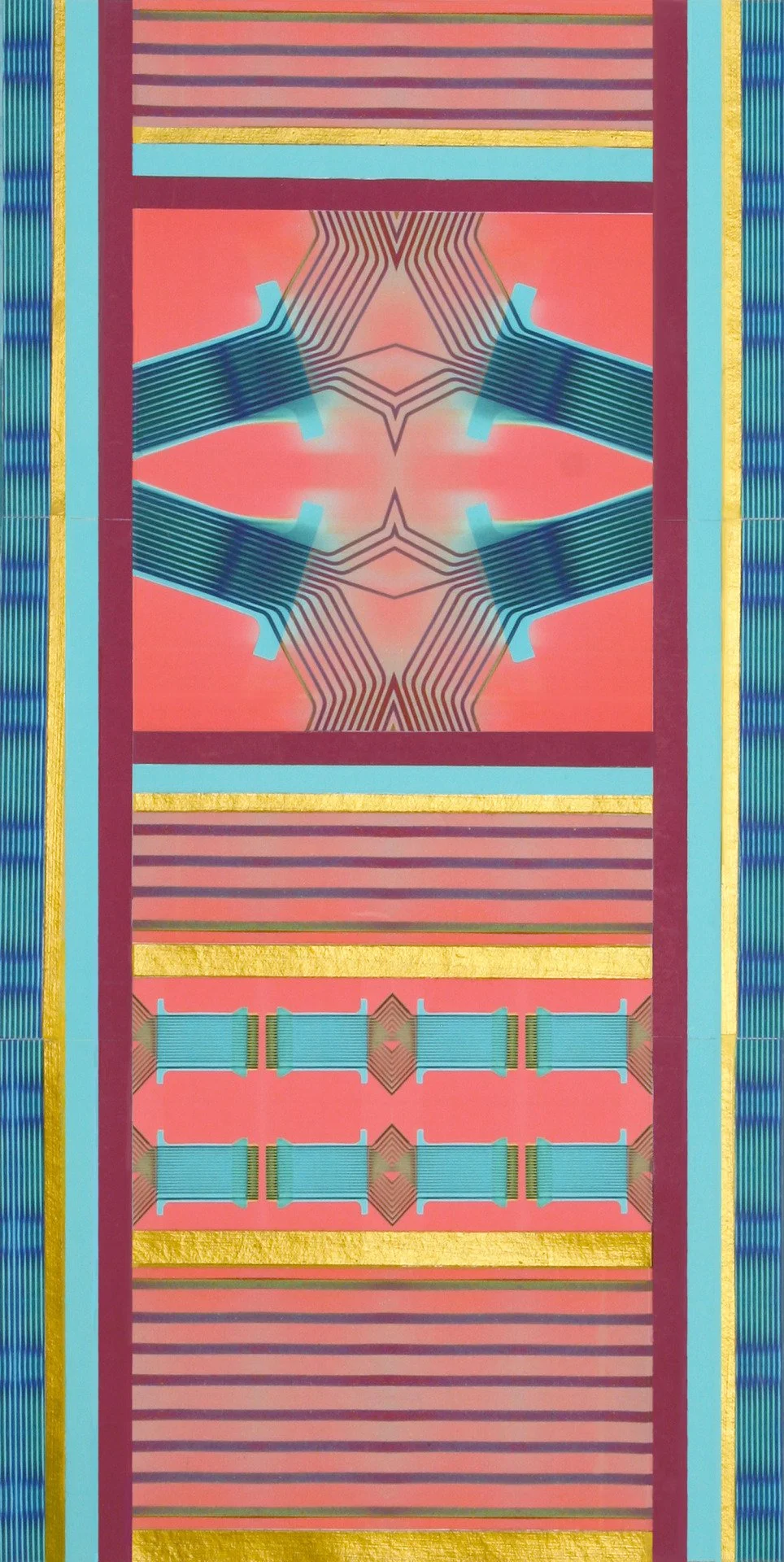
KB095-3, 2014 Collaged digital scroll, inkjet printed on Japanese kozo paper, gold acrylic paint, Tyvek backing, 96 x 48
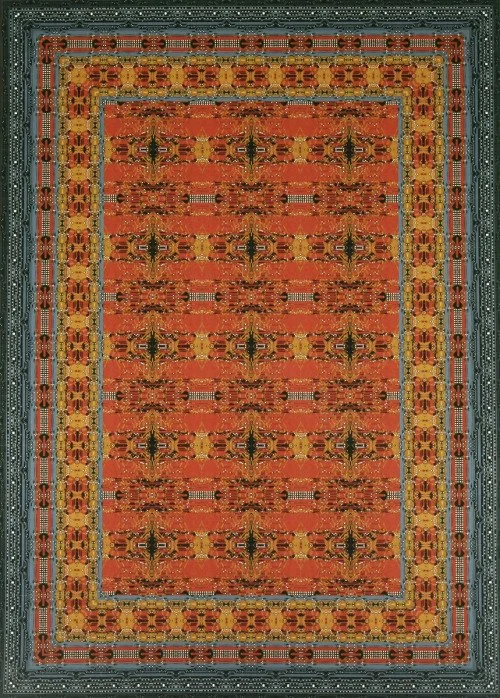
SFL40V0 #17, 2010, Collaged digital images from a circuit board, Epson archival ink, mounted on museum board with MDF and wood backing,
85 x 60 x 1 ¾
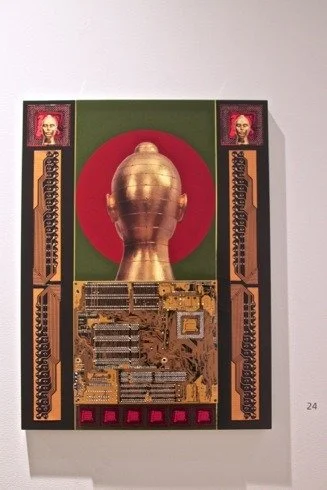
Myth and Memory #7, Elpina, 2003, Collaged digital images from a sculpture and a circuit board, Epson archival paper, a circuit board, acrylic paint, metallic tape, on board, 18 x 24
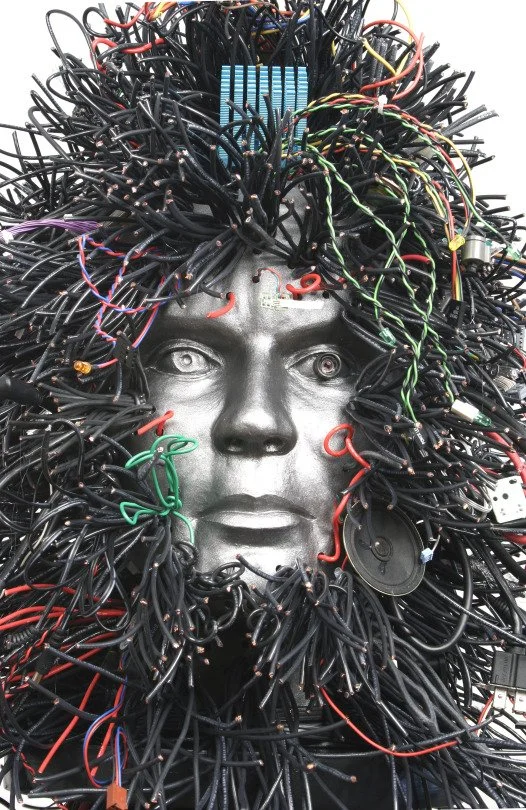
Transhuman Personae #11, 2010, Fired clay, graphite and aluminum powders, acrylic medium, computer parts, cable, wire, tripod, 75 x 46 x 46
ALJIRA: Where did you find the wires and materials for Transhuman Personae #11? What was your process like?
LAY: It’s mostly cable wire. I was following the cable guys around in their truck and asked if they had any scraps. One guy led me to an industrial area in Jersey City where they work. They had a big dumpster where they threw away all their scraps. One of the cable guys there went into the dumpster and started pulling stuff out for me. I also used electrical chords and telephone wires. When I started using computer parts, though, I couldn’t figure out where to get them. I finally sent out an email and asked people to send me their old computer parts. But at first, I went to Techserve, since they rebuild and fix computers, and I asked them what they do with their old parts. They told me they had a dumpster and I could come by. So, I was dumpster diving. Then people started just giving me stuff. Now I have more old computers in my studio than I know what to do with.
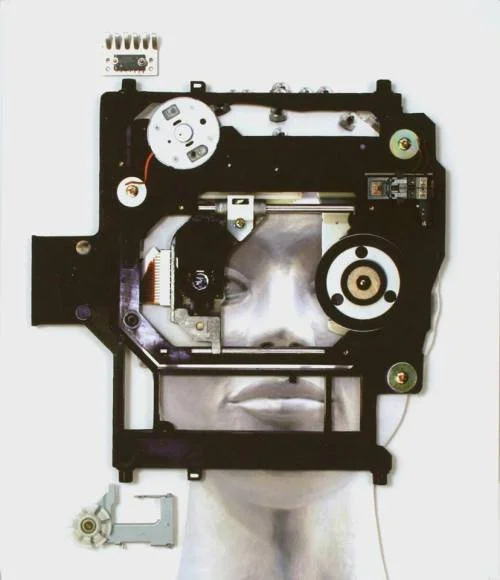
Life Support #14, 2008, Digital assemblage, Epson archival paper, Epson ink, computer parts, archival foam core, museum board, 22 ½ x 20 5/8 x 2 ½
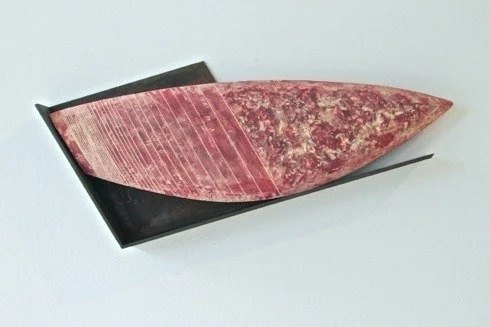
Untitled #1, 1986, Fired clay, steel, clay slip, 12 ½ x 29 x 3
ALJIRA: The use of clay has a stigma that it is material suited more for craftmaking than for fine art. Are you reversing that stigma in your work?
LAY: I think that throughout my entire career I have tried to bring clay out of craft. I’ve always wanted it to be taken seriously as a material for sculpture. It has certain properties the way wood and metal have properties. Of all the materials for sculpture, clay has the most versatility. It can go from organic forms to geometric forms. I think the stigma that clay is a craft material is changing. It’s still there in certain groups but I think it’s not the issue that it was by any means. Clay is taken much more seriously.
In the very beginning I figured out the way to be taken seriously as a sculptor using clay was to combine other materials. So clay and steel are taken more seriously when used together. It’s much more interesting than having the whole thing made out of clay.
I was interested in learning how to weld. The imagery comes from Brancusi who I was inspired by. The most important thing was that I was learning how to weld combining clay and steel.
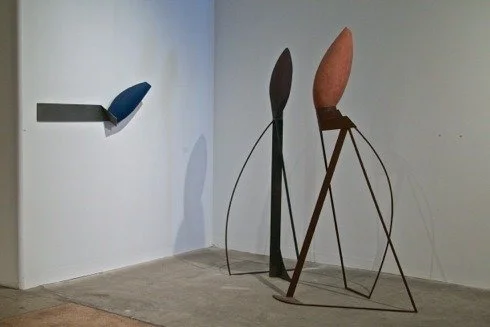
Installation, Photo Credit: Arlington Withers
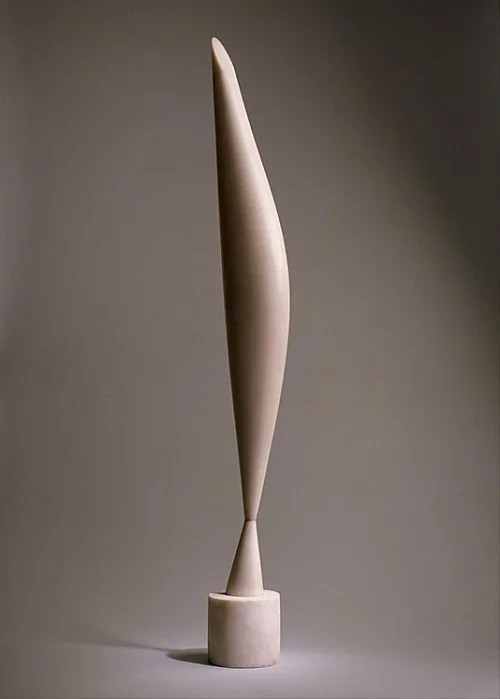
Constantin Brancusi, Bird in Space, 1923, Marble sculpture, 56.75 x 6.5 in., Metropolitan Museum of Art
ALJIRA: In your practice have you been continuing your formal investigations in a different way through each of your various works over the years?
LAY: I’ve always been interested in work from other cultures –African, Oceania, Native American, and more recently Tibet. I think it is very important to acknowledge where you get your ideas from. Everything comes from somewhere. It all comes from somewhere. One really broad general observation I have now is that people really understand the work and the ideas that are in it. I really appreciate that people get it.
Bending the Grid: Pat Lay: Myth, Memory and Android Dreams is on view at Aljira through March 19, 2016. To inquire about Pat Lay’s limited edition benefit prints call 973.622.1600. Gallery hours are Wednesday – Friday, 12 – 6pm
Saturday, 11am – 4pm.